AI Interview Cheating Went Mainstream. Here Is What the 2026 Data Actually Says
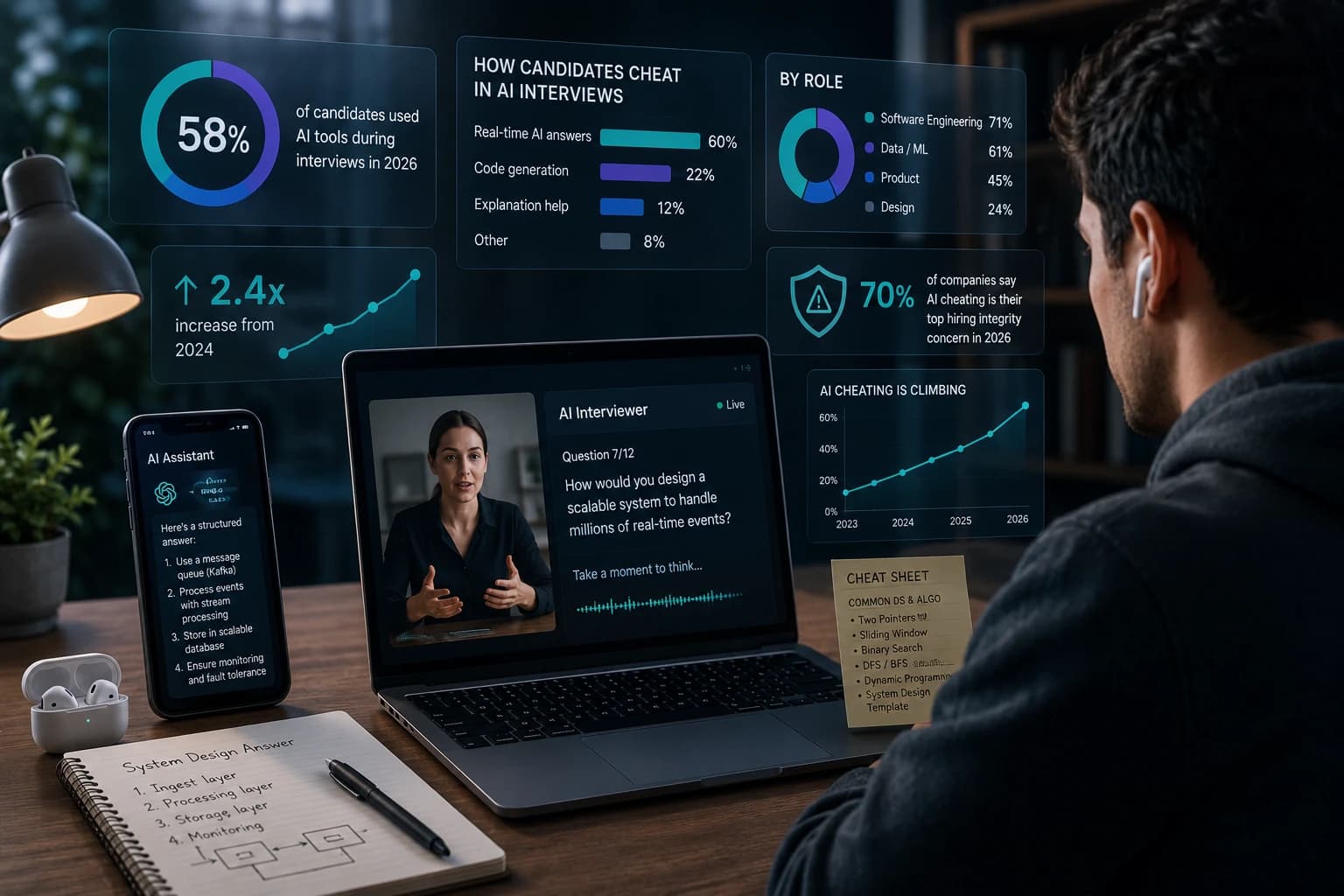
For years, "candidates might cheat with AI" was a hypothetical raised in hiring meetings. In 2026, it is a measured, mainstream phenomenon — and the numbers are moving fast.
The numbers
Fabric's analysis of over 50,000 candidates found that cheating adoption more than doubled in six months — from 15% of candidates in June 2025 to 35% by December 2025. In a follow-up analysis of 19,368 interviews conducted between July 2025 and January 2026, 38.5% triggered cheating flags. For technical roles, the flag rate hit 48% — nearly one in two coding and engineering interviews.
It goes beyond answer-feeding tools. A Gartner survey of 3,000 job candidates found 6% admitted to outright interview fraud — posing as someone else, or having someone else pose as them. Roughly 17% of HR managers say they have already encountered deepfake technology in a video interview. Gartner now predicts that by 2028, one in four candidate profiles worldwide will be fake.
Why the old formats are losing
The formats most exposed to AI cheating share one trait: they give the candidate unobserved time with a static question.
- Take-home assignments are now effectively a test of who has the best AI subscription.
- One-way async video screens give candidates unlimited retries and an off-screen prompt window.
- Multiple-choice assessments were solved the day their question banks leaked — AI just removed the last bit of friction.
What holds up
The interviews that still produce real signal look more like conversations and less like exams:
- Live and adaptive. Follow-up questions that react to the candidate's specific answer are dramatically harder to outsource to a tool than a fixed question list. Depth probes — "why that trade-off?", "what breaks first under 10x load?" — expose borrowed answers quickly.
- Camera on, identity verified. Recorded video with a consistent face and voice across every round raises the cost of proxy interviewing from trivial to criminal.
- Artifacts over answers. A working code session, a system design document built up live, a debugging trace — these show how someone thinks, and the process is far harder to fake than the output.
- Consistency across rounds. When every round is recorded and scored against the same rubric, a candidate whose live performance suddenly diverges from their earlier rounds stands out immediately.
The uncomfortable truth
Some of what gets flagged as "cheating" is really a preview of how people now work: engineers use AI assistants daily, and pretending otherwise in interviews measures the wrong thing. The teams handling this well are explicit about it — they define which rounds are AI-assisted by design and which measure unaided reasoning, then build formats that make each mode observable.
The takeaway is not to interrogate candidates harder. It is that interview formats designed for 2019 are quietly broken in 2026, and the fix is structural: live, conversational, recorded, rubric-scored rounds where the signal is the thinking, not the answer.