A Century of Hiring Research Has a Clear Winner — and Almost Nobody Uses It
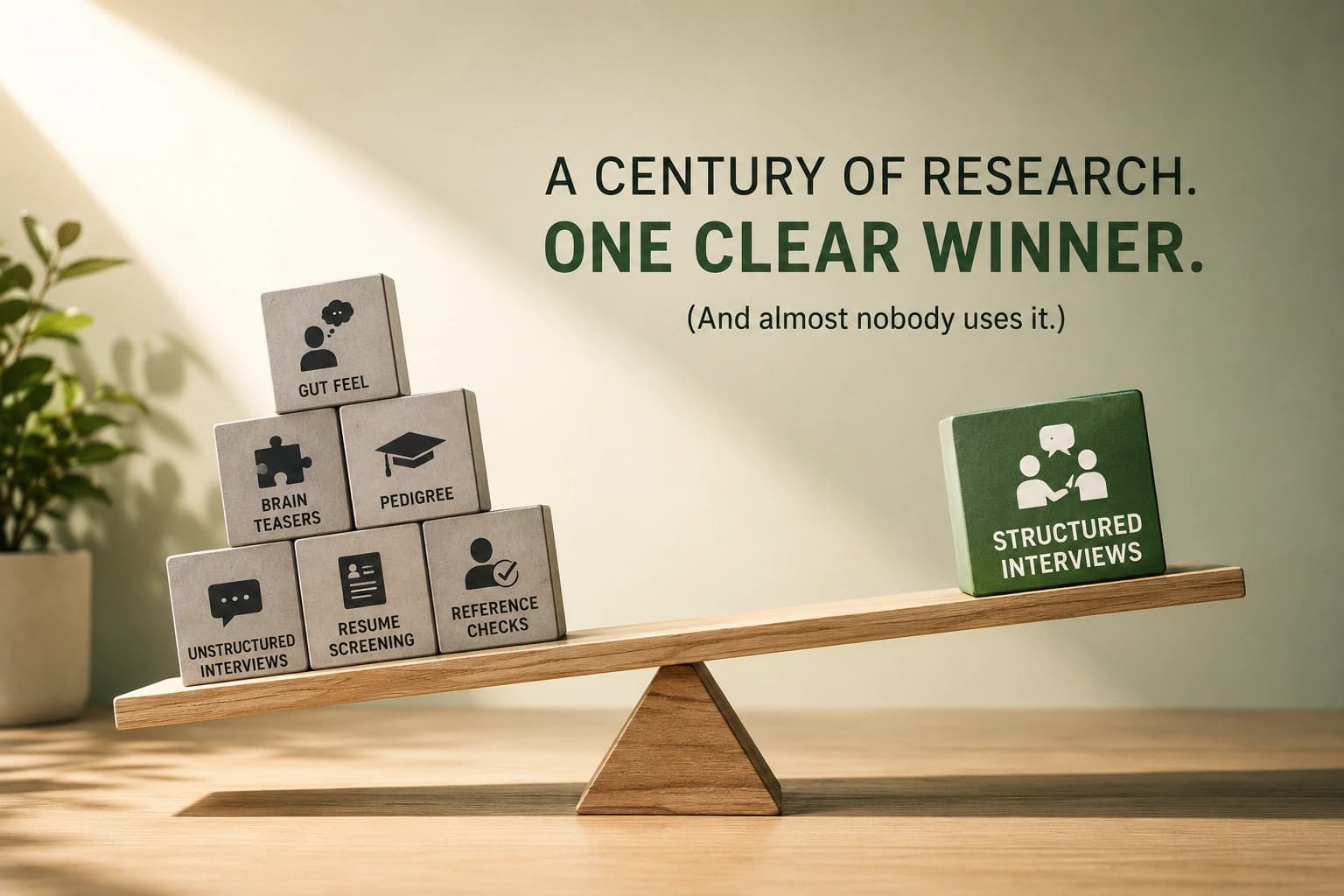
Industrial-organizational psychologists have spent a hundred years measuring which selection methods actually predict job performance. The modern answer is unambiguous — and it is not pedigree, brain teasers, or gut feel.
What the research says
The landmark reference for decades was Schmidt and Hunter's 1998 meta-analysis, which put general mental ability and structured interviews at the top. In 2022, Sackett and colleagues re-analyzed the entire evidence base — hundreds of studies, tens of thousands of workers across 500+ jobs — correcting a systematic statistical bias in the older estimates.
The revised ranking: structured interviews are the single strongest predictor of job performance (operational validity around .42), ahead of cognitive ability tests, work samples, and every other common method. Structured interviews also carry roughly double the predictive power of unstructured interviews, with meaningfully less bias.
Unstructured interviews — the "tell me about yourself" conversation most companies still run — sit far down the list, barely better than reference checks.
What "structured" actually means
Structure is not a vibe; it is a checklist:
- Same questions, same order for every candidate in the role.
- Job-derived content — questions built from an analysis of what the role actually requires, not interviewer favorites.
- Anchored scoring rubrics — each answer scored against written descriptions of what a 2, 3, or 4 looks like, not an overall impression.
- Independent scoring before discussion, so one loud voice doesn't anchor the debrief.
Why almost nobody does it
Every talent leader has seen this research. The failure mode is not ignorance — it is drift. Humans improvise follow-ups, skip questions when time runs short, warm to candidates who mirror them, and score from a gut feeling formed in the first five minutes. Structure decays the moment the interview starts, because enforcing it is cognitively expensive for the person who is also supposed to be listening.
This is exactly the property that makes interviewing a better fit for AI enforcement than almost any other HR process. An AI interviewer does not drift: it asks every candidate the same core questions, probes to the same depth, and scores each answer against the rubric's anchors — every time, at any hour. The human role shifts to where judgment actually adds value: writing the rubric, reviewing the transcript, and making the call.
The compounding payoff
A structured process doesn't just pick better candidates — it produces comparable data. When every candidate for a role clears the same questions and the same anchors, you can audit score distributions, defend decisions, and improve the rubric each quarter. Bias you can see is bias you can fix.
The science has been settled for a generation. What changed in 2026 is that following it stopped requiring heroic discipline.