The True Cost of an Engineering Hire in 2026 (It Is Not the Recruiter Fee)
Ask a finance team what a hire costs and they will quote the recruiter fee and the job-board spend. Ask an engineering manager mid-hiring-push and you will get a different answer: the sprint that slipped because half the team was interviewing.
The benchmarks
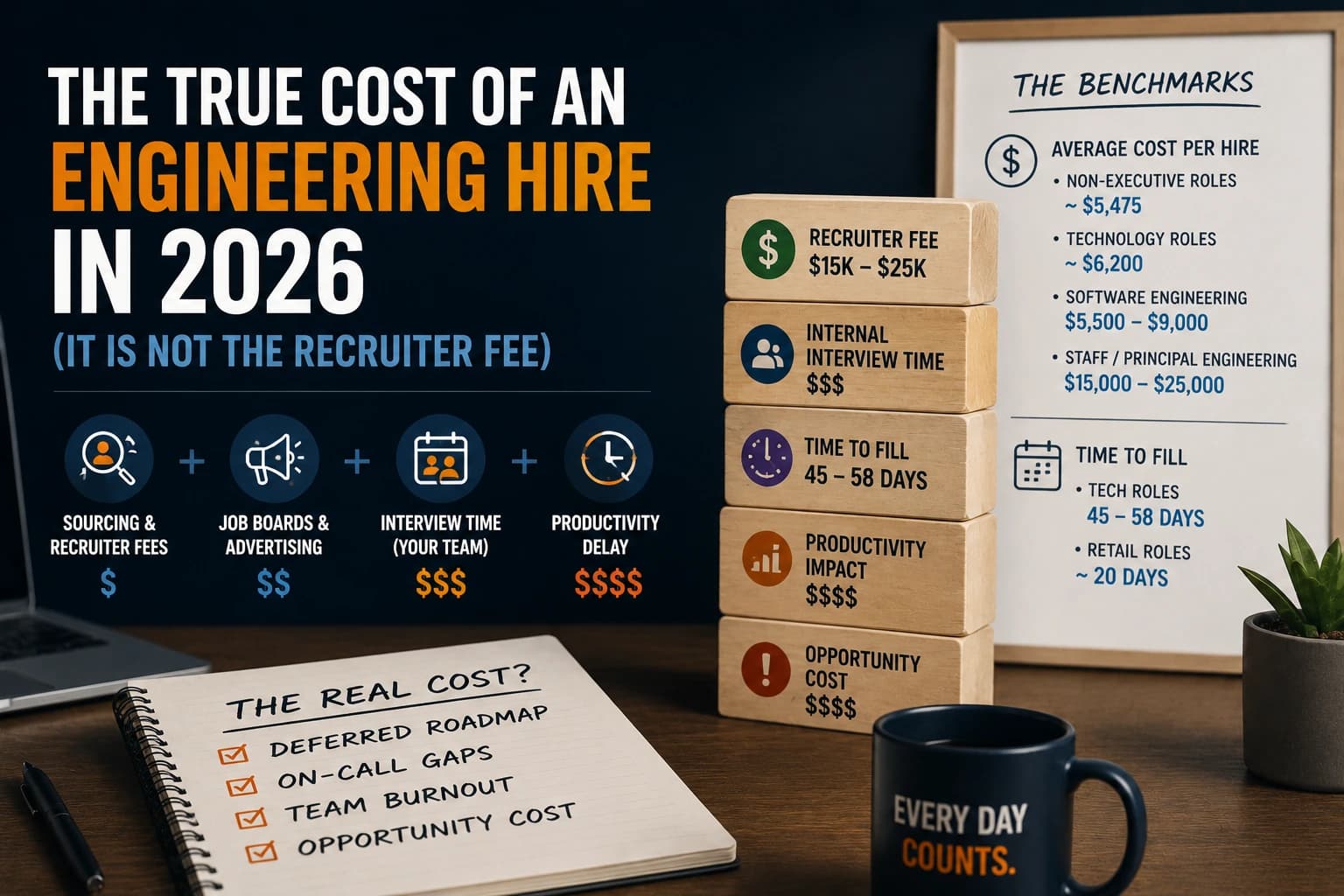
SHRM's benchmark puts the average cost per hire at roughly $5,475 for non-executive roles. Technology roles run higher — around $6,200 on average, with software engineering hires typically landing between $5,500 and $9,000, and staff/principal searches reaching $15,000–$25,000.
Time-to-fill follows the same pattern: tech roles take 45 to 58 days against roughly 20 for retail. That is two months of an unfilled seat — two months of deferred roadmap, on-call gaps, and the quiet overtime the rest of the team absorbs.
The line item nobody books
The most expensive input in an engineering hire never appears on an invoice. A typical loop — resume review, phone screen, coding round, system design, behavioral, debrief — consumes 20 to 40 interviewer hours per hire. At loaded engineering rates of $86–$150 per hour, that is $2,000–$6,000 of engineer time per hire before any other cost.
And that is per hire, not per candidate. With typical pass-through rates, filling one senior role can mean 15–25 interviews across the funnel. Do the math for a team hiring ten engineers a year and you are looking at a full engineer-year spent interviewing — capacity that was budgeted for shipping.
Where the money actually leaks
- Early rounds run by expensive people. A senior engineer running first-round screens is the most expensive possible filter applied at the point of least signal.
- Scheduling drag. Every calendar handoff adds days of time-to-fill, and slow pipelines lose the strongest candidates first — which means re-running the loop, doubling the cost.
- Inconsistent bars. When each interviewer improvises, teams re-interview to resolve disagreements, and mis-hires (which cost multiples of any of these numbers) slip through.
Restructuring the spend
The pattern among teams getting this right is consistent: spend software on the top of the funnel and engineers on the bottom.
Structured, AI-run early rounds — recruiter screens, first-pass coding assessments — run within a day of application, at any hour, at near-zero marginal cost, and produce recorded, rubric-scored evidence. Engineers enter for the final rounds, already armed with transcripts and scores, spending their hours on the judgment call only they can make: do we want to work with this person on our system?
The result is not just a cheaper hire. It is a faster one — and in a market where the best candidates are gone in days, speed is the discount that compounds.